The Astra 1 satellite, positioned at 19.2º East, stands as a cornerstone of satellite broadcasting, delivering a vast array of television and radio services to millions across Europe and parts of North Africa.
Operated by SES, a global leader in satellite communications, Astra 1 is renowned for its ability to transmit over 1,150 channels, making it a pivotal hub for entertainment and connectivity.
This article delves into the unique features of Astra 1, exploring its history, launch milestones, coverage areas, technological advancements, and its critical role in shaping the viewing experience for millions.
A Celestial Gateway: Overview of Astra 1
Astra 1, also known as Astra 19.2ºE, refers to a cluster of satellites stationed at the 19.2º East orbital slot in the Clarke Belt, managed by SES, headquartered in Betzdorf, Luxembourg.
This orbital position was the first utilized by SES, initially named Astra 1, but rebranded in 2008 to Astra 19.2ºE to distinguish it from other Astra orbital slots.
Operating in the Ku-band frequency range (10.70–12.70 GHz), Astra 1 delivers a mix of free-to-air and encrypted television and radio services.
Astra 1 is a powerhouse in European broadcasting, serving over 118.4 million households through 147 transponders (145 in Ku-band and 2 in Ka-band), supporting direct-to-home (DTH), cable, and IPTV distribution.
It is a pioneer in high-definition television (HDTV), broadcasting over 40 HD channels via platforms like HD+ in Germany, elevating the visual quality for viewers.
Its strategic position and robust infrastructure make it a go-to satellite for broadcasters and viewers alike.
A Journey Through Time: History and Launch of Astra 1
The Astra 1 saga began with the launch of Astra 1A on December 11, 1988, marking Europe’s first dedicated direct-to-home (DTH) satellite.
Equipped with 16 transponders, it commenced broadcasting in February 1989, carrying iconic channels like Sky Television and MTV Europe.
This was followed by Astra 1B in 1991 and Astra 1C in 1993, introducing SES’s innovative “co-location” strategy, where multiple satellites are positioned within a 150 km orbital cube to ensure redundancy and flexibility.
In 1994, Astra 1D was launched, initially intended for digital broadcasting but adapted for analog due to market demand. The transition to digital began with Astra 1E in 1995, setting the stage for subsequent satellites like Astra 1KR, 1L, 1M, and 1N.
The latest addition, Astra 1P (also known as SES-24), was launched on June 20, 2024, via a SpaceX Falcon 9 rocket. As the most advanced satellite in this slot, Astra 1P boasts 80 Ku-band transponders capable of delivering 500 HDTV channels.
In February 2026, all services from older satellites (Astra 1KR and 1L) were migrated to Astra 1P, paving the way for their retirement.
Spanning Continents: Coverage Areas of Astra 1
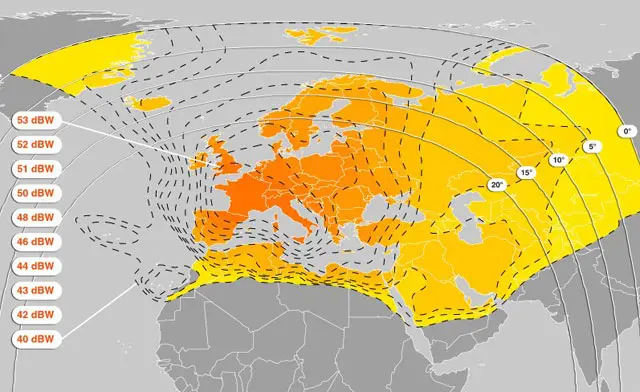
Astra 19.2ºE is strategically positioned to serve a vast geographical footprint, primarily focusing on Europe and extending to parts of North Africa. Key regions include:
-
Germany, Austria, and Switzerland: Serving 42 million TV households, Astra 1 is a market leader in Germany, powering platforms like HD+ and ZDF with robust channel offerings.
-
France: Reaching 17.5 million households through providers like CANAL+ and Orange, it supports both free and pay-TV services.
-
Spain: Covering 7.5 million households via Movistar+ (Telefonica), it delivers international and local channels.
-
North Africa: Providing coverage to countries like Morocco, Algeria, and Tunisia, where it supports DTH services.
-
Other Regions: Including Belgium, the Netherlands, Poland, parts of Italy, and Eastern Europe, with signal strength varying by location.
Astra 1 utilizes multiple beams, such as the wide European beam for Northern and Central Europe and targeted beams for Spain and Southern Italy. Its proximity to Astra 23.5ºE allows viewers to receive channels from both positions using a single dish with a Duo LNB, enhancing installation efficiency.
Cutting-Edge Innovation: Technical Features of Astra 1
Astra 1 is distinguished by its advanced technology, setting benchmarks in satellite broadcasting:
-
High-Definition Broadcasting: A trailblazer in HDTV, Astra 19.2ºE delivers over 40 HD channels, with platforms like HD+ offering premium visual experiences.
-
Co-Location Strategy: Multiple satellites in the same orbital slot ensure seamless service continuity and resilience against technical failures.
-
Astra 1 Sports Platform: Launched in 2022, this service optimizes sports content delivery, supporting high-quality live broadcasts across Europe.
-
Efficient Bandwidth Utilization: The Ku-band transponders, especially on Astra 1P, maximize channel capacity, enabling the transmission of hundreds of HD and SD channels.
-
Digital and Encrypted Services: Supports a mix of free-to-air channels and encrypted services via smartcards, catering to diverse viewer preferences.
The introduction of Astra 1P in 2024 marked a leap forward, with its enhanced transponder capacity and energy-efficient design, ensuring long-term sustainability and superior performance.
A Viewer’s Paradise: Channels and Services
Astra 19.2ºE hosts a staggering 1,150+ television and radio channels, making it a viewer’s paradise. Key offerings include:
-
German Market: Channels like RTL, ProSieben, Sat.1, and public broadcasters ARD and ZDF, alongside HD+ exclusives like RTL UHD.
-
French Market: CANAL+ bouquet, TF1, M6, and free-to-air channels like France 2 and France 3.
-
Spanish Market: Movistar+ channels, including sports, movies, and international content like BBC World News.
-
International Channels: A mix of news (e.g., CNN, Al Jazeera), entertainment (e.g., MTV), and niche channels for expatriate communities.
-
Radio Services: Hundreds of radio stations, including BBC Radio and regional European broadcasts.
The satellite supports both standard-definition (SD) and high-definition (HD) channels, with a growing emphasis on ultra-high-definition (UHD) content, particularly for sports and premium movies.
Tips for Receiving Astra 1
To access Astra 1’s vast channel lineup, proper equipment and setup are essential. Here are key tips:
-
Dish Size: A 60-80 cm dish is sufficient for Central Europe (e.g., Germany, France). In fringe areas (e.g., North Africa or Eastern Europe), a 90-120 cm dish is recommended.
-
Dish Alignment: Use a satellite finder or app (e.g., DishPointer) to align your dish to 19.2ºE, ensuring a clear line of sight.
-
LNB Selection: A Universal Ku-band LNB (9.75/10.6 GHz) is ideal. For multi-satellite reception, use a Monoblock or Duo LNB.
-
Receiver Compatibility: Ensure your receiver supports DVB-S/S2 standards for SD, HD, and UHD channels. Smartcards may be required for encrypted services.
-
Signal Check: Aim for 70%+ signal quality on your receiver’s setup menu to avoid disruptions.
-
Weather Considerations: Secure the dish to withstand rain or wind, as Ku-band signals can be affected by adverse weather.
The Future of Astra 1
Astra 19.2ºE continues to evolve, with SES investing in next-generation satellites to meet the demand for high-quality content.
The deployment of Astra 1P underscores SES’s commitment to sustainability, with its all-electric propulsion system reducing launch costs and environmental impact.
Future advancements may include broader UHD adoption, enhanced interactive services, and integration with hybrid satellite-IPTV platforms.
As streaming services grow, Astra 1 remains a vital complement, offering reliable DTH broadcasting to areas with limited internet connectivity.
Astra 1 at 19.2ºE is more than a satellite—it’s a gateway to entertainment, connecting over 118 million households with a rich tapestry of television and radio content.
From its pioneering launch in 1988 to the cutting-edge Astra 1P in 2024, it has shaped Europe’s broadcasting landscape with its extensive coverage, technological innovation, and diverse channel offerings.
Whether you’re in Germany watching HD+ or in North Africa tuning into free-to-air channels, Astra 1 delivers unmatched reliability and quality.
By following the reception tips and staying updated with transponder settings, you can unlock the full potential of this broadcasting beacon and immerse yourself in a world of entertainment.
Steps to Align the Satellite Dish for Reception
- Ensure all cables are securely connected.
- Align the dish toward the selected satellite.
- Adjust angles while monitoring signal indicators.
- Fix the dish once the best quality is achieved.
After completing alignment, scanning for channels allows access to newly added frequencies and updated broadcasts.
Search for a New Channel
- Navigate to the receiver menu.
- Select search or scan options.
- Run the scan.
- Save the detected channels.
Learn more at Search for a New Channel.
Steps to Align the Satellite Dish for Reception
- Install the dish in an elevated, open location.
- Adjust direction based on satellite coordinates.
- Check signal quality while fine-tuning.
- Lock the position once optimal results appear.
With alignment complete, searching for channels ensures your receiver is updated with the latest available broadcasts.
Search for a New Channel
- Open receiver settings.
- Select channel installation.
- Start scanning.
- Save new channels.
Visit Search for a New Channel for full details.
Types of Satellite Receivers
Satellite receivers are the main devices used to access TV channels. They vary in quality, technology, and additional features. Here are the main types:
1. SD Receivers (Standard Definition)
- Receive channels in standard definition (SD).
- Suitable for older TVs or viewers who do not require high-quality images.
- Usually cheaper and easier to use.
- Do not support HD channels or some modern encrypted channels.
2. HD Receivers (High Definition)
- Support high-definition (HD) quality up to 720p or 1080p.
- Provide clearer images and better colors compared to SD receivers.
- Often support both modern encrypted and free channels.
- Require an HD-compatible TV to enjoy full quality.
3. Full HD / 4K Receivers
- Support Full HD 1080p or Ultra HD 4K for the best viewing experience.
- Ideal for watching sports channels and movies in high quality.
- Include modern technologies such as HDR for enhanced colors and contrast.
- Usually more expensive than standard HD receivers.
4. IP / Internet Receivers
- Use an internet connection instead of or in addition to satellite reception.
- Provide access to channels via IPTV or live streaming services.
- Often come with apps like YouTube or Netflix.
- Require a stable internet connection for the best quality.
5. Hybrid Receivers
- Combine both satellite and internet reception (Satellite + IPTV).
- Allow watching traditional satellite channels and online channels on the same device.
- Offer better search and recording options, sometimes with Catch-up TV support.
6. Receivers for Encrypted Channels
- Support encrypted channels using subscription cards or codes.
- Have high-level encryption protection to access paid channels securely.
- Ideal for viewers of packages like BeIN Sports or OSN.
Important Tip: When choosing a receiver, make sure it is compatible with your TV type (SD / HD / 4K), supports the satellites you want to receive, and includes additional features like recording, replay, or IPTV support if needed.
The History of Television: From Mechanical TVs to Smart Screens
Television has evolved significantly since its invention, transforming the way we consume entertainment and information:
1. Mechanical Television
- Early TVs in the 1920s and 1930s used mechanical scanning systems with spinning disks.
- Images were small, low-resolution, and primarily experimental.
- These TVs laid the groundwork for electronic television technology.
2. Electronic Television
- Introduced in the 1940s, using cathode-ray tubes (CRTs) for better picture quality.
- Allowed broadcasting of standard black-and-white and later color programs.
- Became widely accessible to households, increasing TV’s popularity.
3. Digital and High-Definition TVs
- Digital television emerged in the late 1990s and 2000s, offering improved clarity and more channels.
- High-definition (HD) TVs provided sharper images and better sound quality.
- Transitioned from analog to digital broadcasting for efficiency and quality.
4. Smart Screens and Modern Televisions
- Modern smart TVs connect to the internet, providing streaming, apps, and interactive features.
- Support for 4K and even 8K resolution offers ultra-clear images.
- TVs now serve as entertainment hubs integrating content, gaming, and communication.
Overview of Satellites and Their Use in Satellite Broadcasting
Satellites are artificial objects launched into space to orbit the Earth and facilitate communication, navigation, weather monitoring, and broadcasting. One of their most important applications is satellite television broadcasting, which allows signals to be transmitted over vast distances to homes worldwide.
Early Use of Satellites in Broadcasting
- The first communication satellites were launched in the 1960s, enabling long-distance radio and TV transmissions.
- Early satellite broadcasts were primarily experimental, testing signal transmission between continents.
- By the 1970s, satellites began regular TV broadcasts, reaching regions previously inaccessible.
- Initial broadcasts were in analog format, with limited channels and image quality.
Evolution of Satellite Broadcasting
- The 1980s and 1990s introduced digital satellites, improving signal quality and enabling more channels simultaneously.
- High-definition (HD) broadcasting became possible with advances in compression and satellite technology.
- Modern satellites support thousands of channels, including sports, news, movies, and international content.
- Satellites now also enable interactive TV services, internet access via satellite, and encrypted channels for subscription-based content.
Importance of Satellites in Broadcasting Today
- Provide global coverage, reaching remote and rural areas where terrestrial signals are weak or unavailable.
- Support a wide range of TV services, from free-to-air channels to premium subscription packages.
- Play a critical role in modern communication infrastructure, connecting millions of viewers to news, entertainment, and educational content.